18.2.15

Berlinale 65: my predictions friday at noon...


....
I saw a bear yesterday outside the Starbucks near the Berlinale Palast.

It wasn’t golden,  or even silver.

 Just off-white.

Barely washed and confused, like the rest of us.

So what else is new?

As  I sat down with some south American mates

to discuss prognosis for this year’s awards ceremony,

there were some lifted brows.

Just because we had serious trouble

about a couple of potential winners

(Victoria, Under Electric Clouds),

doesn’t mean that their artistic achievement in a given field
(editing, umm, for Victoria’s one-take  narrative?

Script for the Malick?)

might bait for a bear …

It always helps to remember that
there are no critics in the jury:
just film people,

and film business people,

who don’t really like critics that much.

Jury's Peruvian director and 2009 Golden Bear winner

with her debut film Milk of Sorrows
 Claudia Llosa

sounded the anti-critical bell:

“I know what it’s like to be on the other side” said Llosa.

Tatou stopped reading critics a long time ago

and for her the jury doesn’t vote against,

but for something.

… whilst Daniel Brühl thought the whole thing

might be incredibly tough

and said he’d probably be drinking less than usual…

So, let’s recap:

feelings are important,

and so is honesty,

and so is fairness

and so are first impressions …

 And sobriety.

Based on these criteria (and a few of our own)

we the airborn bunch of global critics, here in this Starbucks,

 like to venture on the following:

Golden Bear for Best Film: Taxi by Iranian dissident director Jafar Panahi.

It’s a small film,

there’s no drinking
either in the film or in Iran (officially)

and the film is full of political honesty

and feelings
at the same time.
Although really not my favorite…

Silver Bear Grand Jury Prize: Ixcanul.

… it’s a small and brutally honest movie,

and has great and emotionally forceful performances

from the two female leads.

Also: drinking too much is bad
and can lead to unwanted pregnancies…

Silver Bear Alfred Bauer Prize for a feature film
that opens up new perspectives: Victoria.

The one-take  isn't actually really new

but it works here as a real-time accelerator

of a small, honest narrative.

And again, drinking

and general consumption of substances

gets some thumbs-down.

Silver Bear for Best Director: Pablo Larrain for El Club

has gone anti-mainstream

with his  brutally honest indictment of Catholic depravities

still leaving a hole open
onto the quest

for genuine faith.

Oh, and drinking red wine

is shown as a degenerate parody

of Catholic rites.

Silver Bear for Best Actress: Charlotte Rampling

in 45 Years.

…tells the story of what can go wrong

in a long-term marriage

as a process of self-awareness.

So honesty? Tick.

Drinking … not so much

…but one of the main characters does start to smoke again

and it doesn’t end well for him.

Silver Bear for Best Actor: Elmar Bäck


as Sergei Eisenstein
in Peter Greenaway’s Eisenstein in Guanajuato.

A: he was mind blowing!!!!!!!

B: the sex scenes were mind blowing!!!!!!
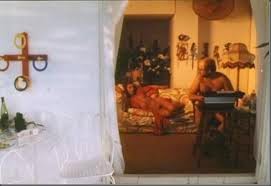
C: Drinking – purely social....

Silver Bear for Best Script: Aferim.

Another art-house movie,

there’s a lot of talking and irreverential humour

to the film’s main goal:

showing the mistreatment of gypsies
and all the sins and charms of the Romanians

in pre nation-State Romania.

Drinking? In connection with boredom

or as a sexual disinhibiter

(ok for young studs,

not so good for older men)

so definitely wrong side of critical levels.

Silver Bear for Outstanding Artistic Contribution in the categories camera,
editing, music, score,
costume or set design.
Might just have to be Pod electricheskimi oblakami (Under Electric Clouds)
for camera,

which was one of the film’s better features.

Drinking – none

(except after the press screening,

when we all needed a stiff vodka)...

Cheers.


giulia dobre – Berlin – Berlinale 65- February 13th

17.2.15

Berlinale 65, a short mumbling about the awards fresh out of the owen...(while I am in the VIP room for post awards interviews)


...berlinale 65 just ended..
..so political, again...politics rul the world...
do they?
...how political the selection and the awards were they?
Kosslick tried to explain:

“I have to say that I was pretty happy …
I do think it’s important that we had these films that people call political because they reflect what’s going on out there. So we weren’t just on the red carpet.
We were out there in the world – just on a red carpet.
For as long as we stay on the red carpet and know where we are the festival has something to do with the world
and is political.
That’s how I see it.
More or less.”

Hmmm.
So is that more or is it less?
Probably a little more.
Which is good if the films match the aspirations.
And some almost did.
See Taxi, which won the Golden Bear.
Very political.
You only had to watch Kosslick bouncing up the red-carpet stairs
to give the Bear
to director Panahi’s niece,
to realize that.
Not that Taxi isn’t
a fair enough work of art.
It is.
But precisely because
it successfully turns dissidence
into art
without sacrificing integrity.
And then the stunning guatemalteque film Ixcanul 
 by Alfred Bauer,
who addresses the lives of ethnic minorities (Maya).
 
 
And then another of my favourites, my Romanian Aferim! (Best Director for Radu Jude)
did the same with Wallachia’s early 19th century gypsies.
 
...and also on the social-political satire El Club (Grand Jury Prize)
and El Botón de Nácar (Best Script),
have strong political meta-texts ...
...even though backed-up by radical artistry,
that sometimes stretched my imagination
beyond breaking point...
 Rewarding Pod electricheskimi oblakami for its camera work
could (just) be considered political:
the film works with epical images 
that suggest the devastation of Russia’s cultural landscapes, 1
00 years after the Revolution!
...From here on in, though,
the prizes went to emotionally charged work,
 in which family dramas opened
onto issues of non-communication:
Best Actor/Actress prizes for the superlative 45 Years,
 
 
Best Director for occasionally inconsistent Body.
...And then, there’s Victoria, which appears to have won a prize (camera, Outstanding Artistic Contribution)
for the cinematographically bedazzling re-creation
of a moral no-man’s land
in my beloved Berlin-Mitte.
Thank you, host city.

So... yes, it’s political...
And not a whisper
for the two big-name films:
Terrence Malick’s Knight of Cups,
Peter Greenaway’s Eisenstein in Guanajuato (my mind, soul and body last blow up!!!!!!!)!!!!!!!!!!!!...

Au contraire: about those ex aequo extra bears.
Ex aequo et bono translates to
“according to the right and good"
or what is “just and fair”
and refers to
“the power of the arbitrators
to dispense with consideration of the law
and consider solely
what they consider to be fair
and equitable
in the case at hand”.
In other words,
officialese for the Jury’s validation
of Kosslick’s selection
by presenting two extra bears...
 
giulia dobre - berlin -February 14th 


16.12.14

"Ida" award for the best 2014 european film at the EFA in Riga...bof....


Yes, I know” IDA” is receiving sparkling reviews and awards.

But director Pawel Pawlikowski’s ode to his homeland is not only puerile, it’s also insensitive to Jews and Catholics.

But, boy, does his film look terrific!

It is shot in gorgeous black and white, and formatted in a 4:3 ratio that makes it look like it was filmed way back in 1962,

the year in which the story is set.

It also displays two amazing performances by Agata Kulesza and newcomer Agata Trzebuchowska. The latest - a fresh-faced teen who was discovered – shades of old Hollywood – in a Warsaw coffee shop.

Not only is she of a gaminesque beauty, she’s also an outstanding actress, which makes it all the more frustrating that the script by Pawlikowski and Rebecca Lenkiewicz is shot full of holes.

In it, Trzebuchowska plays an 18-year-old novice nun one week before her final vows. Before that lifetime commitment, Mother Superior insists that the orphaned travels to Lodz to meet the communist aunt (Kulesza) she never knew she had.
 

There rests the first of the script’s many holes. Why would the monastery wait so long to tell Anna about her long-lost relative?

Yet, that might have been forgivable if the tale didn’t turn so ridiculous… beginning with Anna learning for the first time that she’s indeed Jewish and her real name is Ida Lebenstein.

Again, why would they keep that from her?

Neither does the road trip Anna/Ida takes with her Aunt Wanda to the family village, now occupied by the trashy clan that killed Anna/Ida’s parents during the Nazi occupation.

"What are you thinking about?”  nun Anna is asked toward the end of “Ida.”

“I’m not thinking,” she replies.

As far as the viewer is concerned, her mind may very well be empty. Because such is the dead interior life she’s given over the film’s 80 minutes. Asked to do little more than gaze with wide eyes at the world around her, Agata Trzebuchowska’s character is blank for most of the film. Only in the final scenes does she transform into something more than a passive observer.

But by then, it’s too little too late…


Along the way, the women pick up a handsome sax player (Dawid Ogrodnik), who turns out to be a dreamboat. And the way he plays Coltrane is just enough to persuade the virginal Anna/Ida to exchange her habits, for a passionate roll in the sheets.

Assuming Aunt Wanda, a Soviet judge by day, and a self-confessed “slut” by night, doesn’t get the guy first…

It only gets worse when the film enters an almost darkly comic third act.

There a person leaps out a window and Anna/Ida indulges in a night of sexual and substance-abusing debauchery, before strolling back to the convent.

Not only is it all silly, it doesn’t make a lick of sense in the context of the story.

 It’s as if Pawlikowski (director of the vastly superior “My Summer of Love”) decided to make stuff up as he went along.

When composing his shots, Pawlikowski has, though, the eye of a painter. He is constantly moving his characters, and the viewer’s eyes, around the edges of the frame.

He’s a top visual stylist who understands the virtues of letting scenes breathe. His long takes and distant framings offer the film a quiet, observational grace.

But cinema is (for most of us) a narrative medium.

We want stories, not visual art exhibits, with characters who think and feel and, in turn, make us think and feel.


The point he’s attempting to make via the two women is that one is oppressed by the Soviet regime, and the other by a religion that’s not even her birthright.

But it all feels uninvolving, stirring unintended giggles, instead of the tears he desperately seeks.

It’s such a waste,  because the look, the mood and the subject matter are worthy of so much more than “Ida” offers.

Which is sadly as dull and austere as life in the Soviet countries...

By giulia dobre