29.4.18

How green was my GARDEN


The past is indeed a foreign country.
This means it is often filmed as such,
with an eye for the exotic otherness
that makes it an alien zone.
But Sonja Kröner made with THE GARDEN
a quietly assured, gentle tragic comedy.
An scented film
that delivers the portrait of a bourgeois German family’s 1970s summer
that feels deliciously and authentically as present-tense.


All images here are so piercingly accurate
that they feel like real memories.
A foot stepping out of the loop of a garden...
a rim of grime under a fingernail...
are somehow delivered without fetishization or nostalgia.
The cumulative effect is to make “The Garden” feel like an auspiciously evocative debut,
even if it delivers more on atmosphere
than on fully nourished story.


 Chintzy patterns,
vintage cars,
and space hoppers
are all present and correct in Sonja Maria Kröner’s ode
to the languorous West German summers.

It generates a mood of easy, lived-in authenticity.


The Garden assembles three generations
of an affluent family
at their beloved summer bungalow,
following the death of the grandmother.
Discussions about the future of one of the garden plots sow tensions.
The children squabble over the treehouse,
and try to kill as many wasps as possible...
...and the news that a local girl
has been kidnapped
imbues the bungalow next door
with a sense of danger.
The only thread that somewhat
raises the pulse revolves around one aunt’s
repressed lesbian longings.


In the background,
there’s a buzz of foggy unease.

The radio burbles that story of the missing child... 
the newspapers print salacious details
of the crime
for the old ladies to tut about over tea... 
wasps keep multiplying;
and,
like all good childhood vacation spots,
there’s  the mysterious “artist”
who lives just over the fence,
whose art betrays an interest in doll mutilation...


The family relationships
are not drawn especially clearly,
but that adds to “The Garden’s” choral,
lazy-days feel.
This is family in the most recognizable
and honest sense.
People  take each other for granted and nurse favoritism. 


That is an indolent, hot summer.
Nothing and everything happens.
A tree falls...
plants get watered...
a birthday is celebrated...
kids are lost, found and grounded...
one of the older generation is politely asked
to stop sunbathing nude...
Ilse the old aunt
seems on the verge of a tentative
of same-sex romance,
but is made to feel ridiculous
for wearing lipstick to lunch.
The children bounce around on Hoppity Hops, venture
into the forbidden territory
beyond the fence...
and sing a childishly racist song
that refers to child murder and cannibalism...


The images are rich,
in a precisely calibrated palette.
The framing from DOP Julia Daschner
sometimes sacrifices discipline for immediacy.
But more often it picks out
nicely observed moments of humdrum activity,
like making a bed with blankets
rather than a duvet,
or briskly cleaning one’s nails
with a nail brush.
The locations, interiors and costuming
are terrific,
with every corner of this contained,
microcosmic world
feeling authentic to its 1970s German setting.
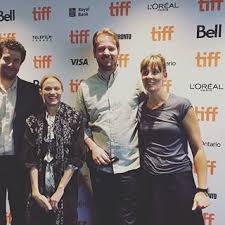


And, perhaps most impressive of all
for a neophyte director,
Kröner gets natural,
unselfconscious performances
from every member of her big,
generations-spanning ensemble,
playing a family
who may be nothing like your own,
but who will remind you
of them
anyway.

By Giulia Ghica Dobre


Production: (Germany) A Prokino Filmverleih presentation of a Walker + Worm Film production, in co-production with Bayerischer Rundfunk and Westdeutscher Rundfunk.
Producers: Philipp Worm, Tobias Walker.

Crew: Director, screenplay: Sonja Maria Kröner. Camera (color): Julia Daschner. Editor: Ulrike Tortora.

With:

Thomas Loibl, Laura Tonke, Ursula Werner, Mavie Hörbiger, Günther Maria Halmer, Christine Schorn. (German dialogue)


8.12.17


Beast  is an assured directorial debut
that's half claustrophobic family drama (in the manner of Lars von Trier),
and half serial killer whodunnit.
At the 58th Thessaloniki International Film Festival this last November,
I watched one afternoon
this ambitious and suspenseful slow-burner,
who manages to thrill and grip its audiences
from the offset.
It is set in a windswept Jersey,
which looks more like an out-of-season south of France.
And it is just a very beautifully acted
and fantastically shot tale of mystery,
rebellion and passion.
There is in this film a genuine air of ambiguity and intrigue.
 It begins with a strong and engaging opener
that leaves you feeling like you know exactly what’s happening…
…and then spends the rest of the film making you doubt yourself.
So it’s just a question of whether the bad boy is a killer, 
and if the couple are going to end up together.
It is a version of Hitchcock’s Suspicion and Hitchcock’s The Lodger.
It is a tale older than time. 
As old as the Victorians…
In Beast, there are a number of fairy tale-type characters dealing with several issues.
Moll is clearly a Cinderella-type character.
She is governed by her family
and subdued into doing everything with a smile.
But there’s no fairy godmother here.
Who could provide useful advice
or a carriage to take her away.
And although Pascal appears to be Prince Charming,
there’s always the risk
that he’s actually the Big Bad Wolf
killing little girls in the woods.
Meanwhile, Moll’s mother and siblings fulfill
the villainous roles usually designated
for step-family. 
At some point it would seem their control began  in the best interest of Moll.
But as time passed,
it turned ugly and oppressive.
When Moll (Jessie Buckley) ducks out of her own birthday party,
she has no idea
how much that night will change her life.
After she rejects a man’s advances,
she is rescued by Pascal (Johnny Flynn),
a local poacher, a hunter, blond, fascinating.
He threatens the man at gunpoint,and then escorts her home safely…
But young women are being found murdered around.
So, as Moll begins a relationship with her rescuer, the police become convinced
that he is the man doing the killing.
Moll embarks on a recklessly torrid affair
with the young man,
her absolute partner
in boundless eroticism and animae.
She then feels more alive
than she has ever felt before.
The narrative is driven by this awakening
and hope for liberation, ignited by Pascal. 

The pace of the story is woven together beautifully.
There is a golden kind of mystery
deepening throughout
and luring you in.
It’s intriguing and chilling,
and packed with raw and complex emotion.
Visually, Beast is a thing of beauty.
It enchants
by the stunning and moody landscape,
by the magic chemistry between the lovers. 
It perfectly blends fear and charm.
So that you’re never entirely sure
if you should feel afraid,
 or protected.
At this point Beast embarks on focusing
on the issue of suspicion.
Suspicion that also creeps into the mind of the spectator,
who never sleeps.
For Moll it is enough to trust those whom we love, those close to us,
but not ourselves.
That trust however will come to crack.
And the psychic disturbances of the protagonist will confuse the waters even more. 
And the relativism of truth
is combined with
an ethical relativism.
Are we all potential killers,
beasts,
if the conditions, extreme or mad,
lead us to more?
Moll has her own skeletons in the closet:
 as a girl she had tried to strangle a schoolmate.
Nobody saves himself among the characters of this film.
 Including the figure of the apparently good-natured inspector,
who then comes to abuse his prerogatives.
Buckley is a revelation as Moll,
offering a performance that is hypnotic.
There’s a scene very early on
when she is getting ready for her party
that is incredibly simplistic,
but conveys so much.
In this dialogue-free moment,
she fixes her hair,
adjusts her dress
and puts on her smile 
– and you just know that
she is worth following through this story.
But the film really belongs to Buckley and Flynn couple.
Buckley and Flynn have a strong understanding
of their characters’ nuances,
 as each new layer presents
a fresh challenge for their relationship.
Although Moll is in her late-twenties,
this is still a coming-of-age story.
Pascal gives her the confidence she needs
to become her own person.
However, she finds independence when  taking her own decisions.
This engenders other problems
that she must address
before the film’s conclusion.

With Beast, writer/director Michael Pearce has made something
that is thought-provoking like a motorcycle ride with a forbidden lover,
and often shocking.
And yet
it is a beautifully subtle
and underplayed film.
A beautifully twisted delight.
Buckley gives a breakout turn
as a young woman wrestling
with the beast within.
These stories of trauma
and memory
were unsettling tales,
 that lingered in my mind 
long after the credits rolled.

Giulia Dobre
December 8th, 2017